
Before most people had broadband. Before smartphones. Before Google had ever pointed a camera at a street. Virtual tours existed, and someone was already making them commercially in the United Kingdom. That someone was Eye Revolution.
This is the history of virtual tours, told from the inside. It is a history of formats that rose and fell, of platforms that made and broke businesses overnight, and of a medium that went from niche novelty to everyday expectation. It is also, inevitably, the story of a company that has been here for all of it.
The Beginning: How the Virtual Tour Was Invented
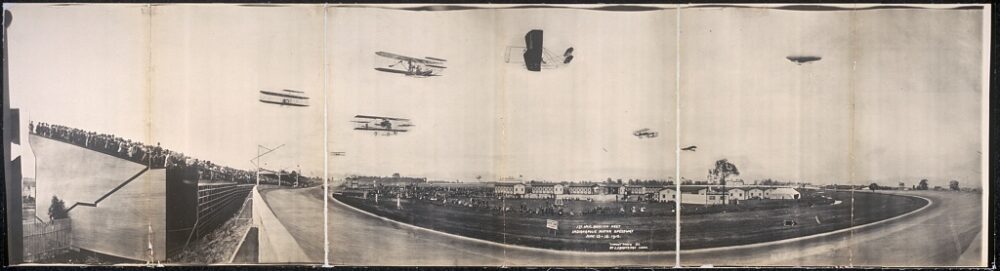
The idea of capturing a panoramic view and letting someone explore it is older than the internet. Nineteenth-century photographers used specialised rotating cameras to stitch wide-angle prints that wrapped around exhibition halls. By the early twentieth century, the Cirkut camera was producing seamless panoramas of sports crowds and civic gatherings that still look extraordinary today.
But the interactive virtual tour, the kind where a viewer can look around freely and navigate through a space, has a specific origin: Apple’s QuickTime VR, launched in 1994.
QuickTime VR let photographers stitch together a series of still images into a navigable panoramic node. For the first time, a viewer could drag their mouse and feel as though they were standing inside a photograph. It was a genuinely new thing. It was also slow, technically demanding, and limited to people with the right plugin, the right hardware, and the patience to wait while dial-up connections transferred files measured in megabytes.
The limitations were severe. In the mid-1990s, the average UK internet connection ran at 28.8 or 56 kilobits per second. A single virtual tour could take many minutes to load. The QuickTime plugin had to be installed separately, and a significant portion of users would not bother. Distribution was largely physical: CD-ROMs, intranets, kiosk installations.
None of that stopped the people who could see what the technology was going to become.
A Medium in Its Infancy
Will Pearson, who would go on to found Eye Revolution, was studying analog photography and darkroom technique in the mid-1990s. The experiments that followed, with panoramic stitching and early digital capture on one of the first consumer digital cameras available*, were the seed of everything that came after. Working from north London, he was part of a community of photographers whose standards were set by advertising work and art rather than by what the technology made easy. That instinct, to treat photographic quality as the fixed point and technology as the variable, has shaped Eye Revolution’s approach ever since.
By around 2000, operating under the name Digital Dream World, Will was already producing commercial virtual tours using Apple’s QTVR platform. The clients were real: food industry facilities, large manufacturing sites, entertainment venues. The constraints were equally real. Broadband had barely arrived in the UK. The QuickTime plugin was not reliably installed on most computers. Each project was a genuine technical and logistical challenge, not just a creative one.
This period also produced the first major legal drama in the industry’s short history. IPIX Corporation, a US company, held patents it claimed covered the entire technique of creating interactive 360-degree panoramas from fisheye lenses. Through the late 1990s and into the 2000s, IPIX pursued licensing fees aggressively and initiated litigation against competitors and practitioners. The chilling effect on the industry was substantial. IPIX ultimately filed for bankruptcy in 2006, but the years of legal uncertainty had already shaped which businesses survived and which did not.
Meanwhile, the technical community was finding its own solutions. Helmut Dersch, a German mathematician, released Panorama Tools in 1998: open-source software for stitching and correcting panoramic images. The accompanying Java-based viewer, PTViewer, offered a browser-based delivery method that did not require the QuickTime plugin. It was slower and less polished, but it worked on more machines. For practitioners navigating the plugin problem, Java applets became a viable middle ground.
The industry was small, technically demanding, legally uncertain, and almost entirely invisible to the general public. It was also, for those prepared to invest in it, wide open.
*Apple QuickTake camera (resolution: 0.3 megapixel – 640 x 48 pixels!)
Flash, Broadband and the First Golden Age
Two things changed the industry fundamentally in the mid-2000s: Adobe Flash and broadband.
Flash was already dominant as a web animation platform when developers began building panoramic viewers on top of it. Unlike QuickTime or Java, Flash had near-universal browser penetration. It required no specialist plugin download for most users. It could handle tiled, multi-resolution imagery that loaded progressively, meaning a tour could begin playing at lower quality and sharpen as the connection caught up. It also allowed a level of interface design and interactivity, hotspots, floor plans, embedded media, navigation menus, that the earlier formats simply could not match.
Broadband adoption in the UK accelerated from 2003 onwards. By 2005, the majority of UK home internet connections were broadband. Virtual tours that had previously been impractical to distribute over the web became viable. The audience expanded from enterprise intranets and CD-ROM installations to anyone with a browser.
For Eye Revolution, this period marked a formal transition. The company moved through Java applet delivery and into Flash-based production as the technology matured. In 2005, Digital Dream World became Eye Revolution, a rebrand that reflected both a more professional positioning and a clearer market identity. In July 2007, Eye Revolution incorporated as a limited company.
Professional stitching tools were also maturing. PTGui, first released in 2001 and continuously developed since, had become the dominant platform for high-quality panoramic stitching. RealViz Stitcher offered a commercial alternative. The workflow was complex but increasingly reliable: shoot on medium-format or DSLR equipment on a precision nodal head, stitch in PTGui, build the interactive layer in Flash. The results, at their best, were visually striking.
Google Street View launched in the United States in 2007. Its arrival was significant not because it competed directly with bespoke virtual tour production, but because it normalised the idea of panoramic photography for a mass audience. Millions of people who had never encountered a virtual tour found themselves dragging through Street View out of curiosity. The medium stopped needing explanation.
The Crisis That Changed Everything
In April 2010, Steve Jobs published a memo explaining why Apple would not support Adobe Flash on iOS devices. It was titled “Thoughts on Flash.” Within the virtual tour industry, the reaction was somewhere between alarm and crisis.
Flash was the delivery platform for the vast majority of professional virtual tours in existence. The iPhone and iPad were, by 2010, the devices that clients were beginning to ask about. A virtual tour that did not work on iOS was a virtual tour with a growing hole in its audience. The industry had roughly two to three years to find a solution before that hole became untenable.
The solution was HTML5 and WebGL: open web standards that allowed panoramic rendering directly in the browser, without any plugin, on any device. The transition required rebuilding delivery infrastructure that had taken years to develop. It also separated the producers who had built their work around a single platform from those who had maintained an understanding of the underlying technology.
Krpano and Pano2VR emerged as the two dominant professional delivery platforms for the new era. Both were built around XML and JavaScript APIs, allowing a degree of programmability and customisation that Flash-based tools had offered but in a more open and device-agnostic framework.
Eye Revolution navigated this transition and came out the other side with its technical approach intact. The Royal Household and 10 Downing Street were added to the Eye Revolution roster. Access to both required considerably more than a shoot brief: security vetting, strict site protocols, and in some cases obligations that don’t expire. Eye Revolution navigated all of it, delivered the work, and kept its counsel. That combination of technical quality and institutional discretion has remained central to the company’s reputation ever since.
In 2013 and 2014, the company received a commission that captured the strange symmetry of the industry’s history: Apple, the company whose QuickTime VR had started everything in 1994, commissioned Will Pearson to shoot multiple 360-degree panoramas in California’s National Parks for their iPhone OS. Spending time in California to shoot work for the brief of his dreams, Will Pearson and Eye Revolution had, in a meaningful sense, come full circle.
Flash was officially end-of-lifed by Adobe in December 2020. By that point, the industry had long since moved on.
The Modern Era: Commoditisation, Specialisation and What Remains
The arrival of the Ricoh Theta in 2013 announced something important: consumer-grade, one-shot 360 cameras were here, and they were going to get cheaper and better. They did. By the mid-2010s, anyone with a few hundred pounds could shoot a passable 360-degree image. By the early 2020s, smartphones with dedicated 360 modes existed.
SaaS platforms arrived to serve the new supply. Matterport built a product around the idea of democratised 3D scanning and virtual tours, complete with cloud hosting, analytics and a simplified workflow aimed at estate agents, hotels and commercial property. Kuula, CloudPano and dozens of similar platforms offered subscription hosting with basic tour building tools. The barrier to entry dropped significantly.
This is, broadly, good for awareness of the medium. It is not the same thing as good production.
What the commoditisation wave made clearer was the gap between a virtual tour as a functional deliverable and a virtual tour as a genuinely considered piece of work. Bespoke capture with professional equipment produces imagery that no consumer camera matches. Considered interface design, accessibility compliance to WCAG standards, integration with a client’s existing digital infrastructure, custom interactivity: these are not things a SaaS platform provides. They require experience, technical depth and a track record of solving problems that template-based tools do not acknowledge.
Eye Revolution has now produced more than 20,000 360-degree images and served over 900 clients since incorporation in 2007. The client list spans the National Gallery, Tower Bridge, The Shard, Harrods, the Royal Household, Land Rover, the BBC, English Rugby, TfL, Honda and Windsor Castle’s Chapel of St George. Services have expanded to include accessible virtual tours built to WCAG standards, 360 video, gigapixel photography, video production, aerial drone imagery, and immersive VR experiences for Meta Quest and Apple Vision Pro.
The industry Eye Revolution entered around the year 2000 was tiny, technically hostile and commercially uncertain. The industry that exists today is mainstream, competitive and in many respects unrecognisable from those early QuickTime VR files loading slowly over a dial-up line. The company has been present, active and adapting throughout.
What Longevity Actually Means
There is a tendency, when writing about company history, to make duration sound like a virtue in itself. It is not. A business can survive for decades by doing adequate work for inattentive clients. That is not what longevity should signal.
What 25 years in this specific field actually represents is a series of forced reinventions. Every major platform shift, QTVR to Java, Java to Flash, Flash to HTML5, desktop to mobile, flat web to immersive VR, has required a decision: rebuild, adapt, or become irrelevant. Eye Revolution has rebuilt and adapted, repeatedly, without losing either the quality of output or the depth of client relationships that make the work worth doing.
When a client brings a sensitive location, a tight deadline, or a brief that requires technical problem-solving alongside creative judgement, the question of who to trust with it is not answered by a feature list. It is answered by a track record.
Eye Revolution’s track record starts before most of its competitors were founded. They have consistently set the standards that others have tried to follow. Over the years, the company has watched approaches it pioneered become industry convention. It has not found this particularly troubling. The clients who care about provenance, standards and genuine expertise have always been able to tell the difference. They still can.
Eye Revolution is one of the UK’s longest-established specialist virtual tour studios, operating since the early 2000s and incorporated in London in 2007. For enquiries, visit the contact page or call +442036030231.
In Summary
- Eye Revolution has been producing virtual tours commercially since around 2000, before broadband reached most UK homes
- The company predates the majority of its competitors and has navigated every major platform shift in the industry
- Early clients included the Royal Household and 10 Downing Street, requiring security vetting and site protocols beyond a standard shoot brief
- Apple, whose QuickTime VR platform originated the interactive virtual tour in 1994, later commissioned Eye Revolution to shoot panoramas in California
- Eye Revolution is one of the UK’s longest-established specialist virtual tour studios, with over 20,000 360-degree images produced across 900+ clients